Colophon
Made like an instrument
Four Forty is an exhibition of one object: a tuning fork, built from measurements and carried through nine rooms.
Rise of Digital, 2026The bench
The object
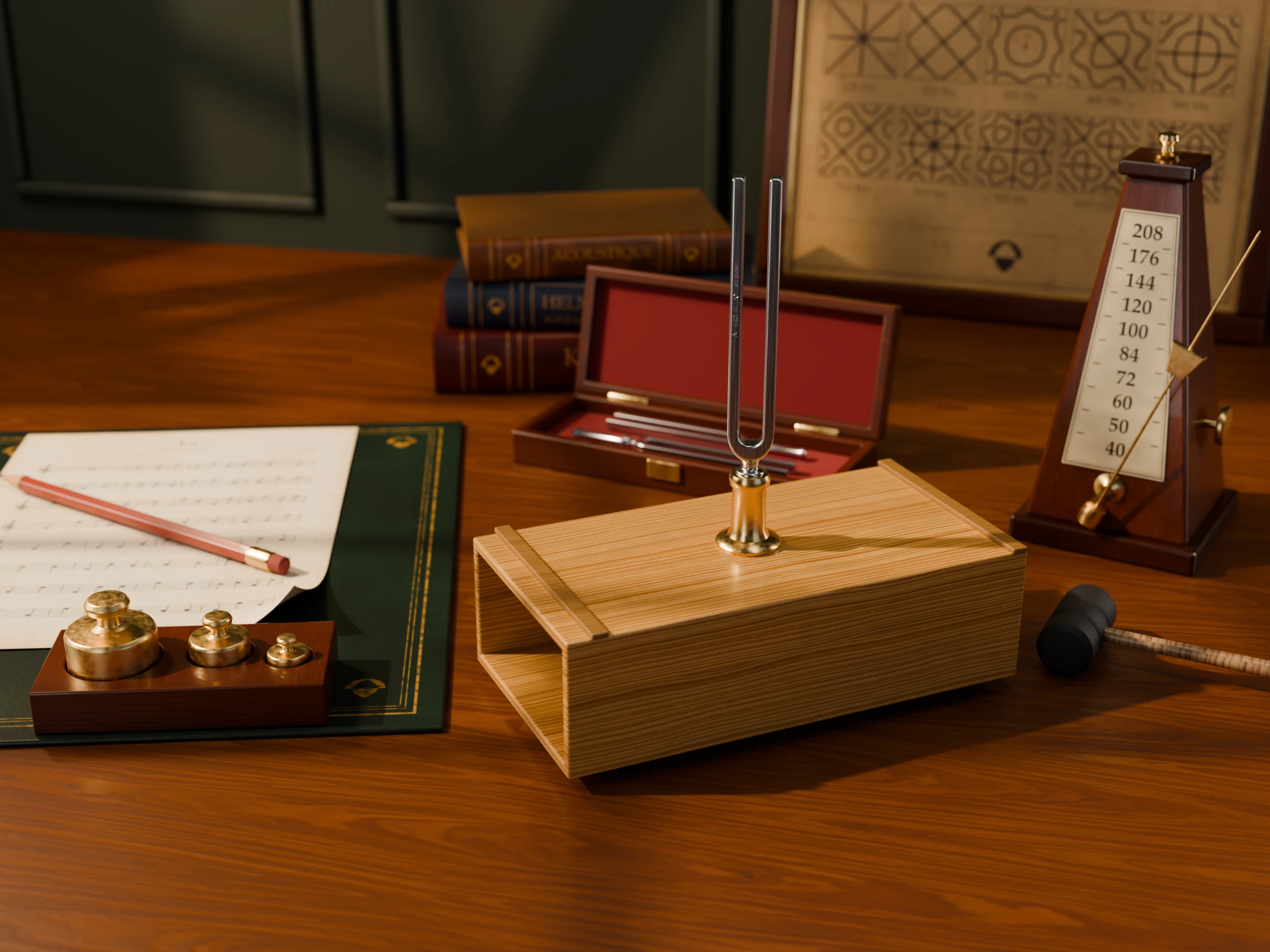
The fork is modelled in Blender as one continuous piece: a rounded steel section swept along a path shaped like a U, joined to a turned stem and blended into a single surface. The engraving and the brushing marks are computed on the metal itself, so they stay sharp at any distance.
- Prong length
- 92 mm
- Gap
- 8.5 mm
- Section
- 4.6 × 7.2 mm
- Resonator
- 182 × 94 × 52 mm
The mark
-
1
A square plate
The symbol is not drawn by hand. It is calculated from a square steel plate, 366.1 mm on each side and 1 mm thick, held at its centre.
-
2
Ringing at 440
The plate rings in mode 2, 5. Sand would gather on the lines that stand still.
-
3
The crossing
Measure from the centre to where the inner oval crosses the diagonal.
-
4
The golden ratio
Multiply that distance by φ and draw a circle with the new radius.
-
5
One phase
Keep one of the two phases inside the circle. Two shapes share this pitch on a square plate, and a fingertip resting on the diagonal picks this one.
-
6
Half a right angle
Turn it by 45 degrees. That is the whole mark.

- Plate
- 366.1 × 366.1 × 1 mm steel
- Held
- At the centre
- Material
- 200 GPa, 7850 kg/m³, Poisson 0.29
- Plate mode
- 2, 5 at 440 Hz
- Resonances shown
- 126, 191, 440, 541, 1057, 1470 Hz
- Circle radius
- φ × oval crossing
- Rotation
- 45°
The light
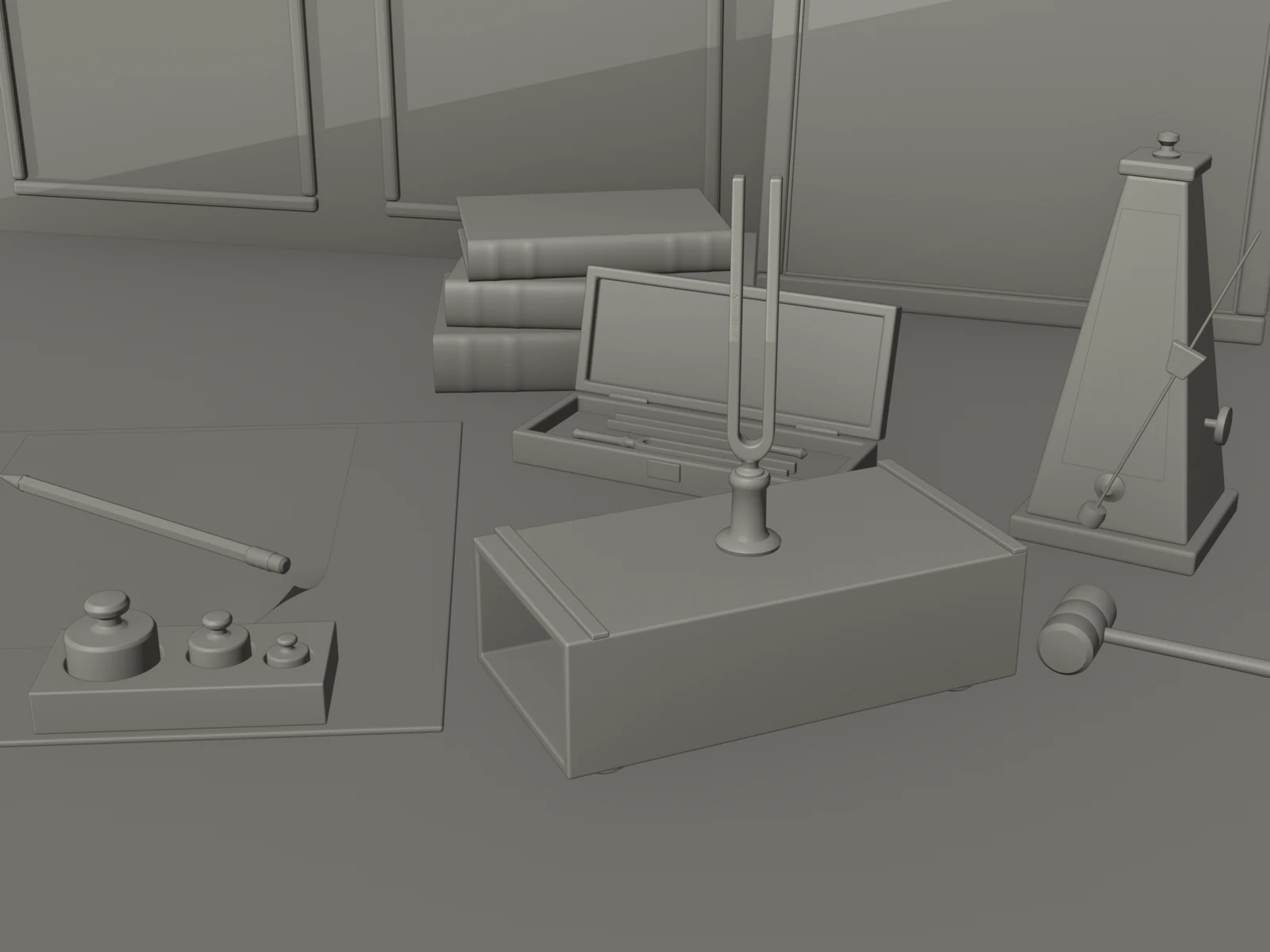
The workbench is lit once, slowly, with path tracing: low sun through a window frame, soft fill from above, a card in front of the steel. That light is stored in the surfaces. In your browser only the metals are calculated live, against a panorama captured from the same room.
Every other room is computed in real time: tens of thousands of grains of sand, a water surface that answers your touch, and a field of points that behaves like pressure in air.
The sound
Nothing here is a recording. Each strike is synthesised in your browser: a fundamental, a faint second partial, the short bright clang near 6.25 times the note, and a few milliseconds of mallet.
The tuner in the coda listens only on your device. No audio is stored or sent anywhere, and the site sets no tracking cookies.
-
Fundamental
The note itself. It lasts.
440Hz × 1 -
Second partial
Faint, an octave up.
880Hz × 2 -
Clang
Short and bright, gone in under a second.
2,750Hz × 6.25
The type
Bodoni Moda, for headlines and numbers. Optical size 28, weight 480
Aa 440
Instrument Sans, for reading.
Aa 440
DM Mono, for measurements. All three are open source fonts.
The colour
- Paper#EFE8DA
- Ink#12100E
- Steel#C9CCD1
- Brass#C79A55
- Signal#E5482C
The sources
Dates and figures were checked against these articles. The plate patterns and pitches are calculated for an ideal plate with thin plate theory (Kirchhoff and Love, solved by the method of Rayleigh and Ritz). They have not been measured on a physical plate. The method was compared with the free square plate values published by R. Porter.
The studio
We build websites in which a product, a place or an idea can be handled instead of described.
Concept, writing, modelling, lighting, sound and code by Rise of Digital.
Wood and plaster surface scans from Poly Haven, released into the public domain. Rendered with Blender and three.js.