Four Forty

Essay

A short history of agreeing

An orchestra can only play together if everyone starts from the same note. Deciding which note took far longer than inventing the tool that holds it.

From 1711 to the present. Press any pitch to hear it.
One note, five numbers. Press two in a row to hear them apart.

A trumpeter's invention

John Shore played the trumpet and the lute for the royal court. In 1711 he made the first tuning fork: two prongs and a stem, nothing that could be wound, bent or retuned by accident.

The fork he is said to have given George Frideric Handel sounds a C, at 512 vibrations a second. A pitch could now travel in a pocket.
Handel's other A

Another fork, from 1740 and also associated with Handel, gives the A at 422.5 Hz. Play it next to a modern A and the older one sits clearly lower, most of the way to the neighbouring key.

Nobody was wrong. There was simply nothing to be wrong against.

Sound becomes visible

Ernst Chladni sprinkled sand on plates, drew a bow along their edges and published the figures that appeared. Sand leaves the parts that move and gathers on the parts that do not.

Vibration, until then something you could only hear or feel, now had a drawing.

The man with the forks

Johann Heinrich Scheibler built a tonometer out of tuning forks, an instrument for measuring pitch. With it he proposed that the A should be 440.

A congress of scientists in Stuttgart approved the number that year. The rest of the world carried on as before.

Drawing with two forks

Jules Antoine Lissajous bounced light from mirrors fixed to vibrating forks set at right angles. The beam traced closed loops when the two pitches stood in a simple ratio, and slowly rolling ones when they were slightly out.

Nathaniel Bowditch had studied the same family of curves in 1815. Lissajous gave them light, and they carry his name.

Pitch by decree

On 16 February 1859 France made 435 Hz official. The standard was called the diapason normal, after the French word for the fork itself.

A government now had an opinion about the note A.

A room at Broadcasting House

In May 1939 an international conference met at Broadcasting House in London and recommended 440 Hz for the A above middle C.

By then music crossed borders by radio. A shared number had stopped being a courtesy.

Written down

The International Organization for Standardization adopted the pitch in 1955 as Recommendation R 16. In 1975 it was formalised as ISO 16.

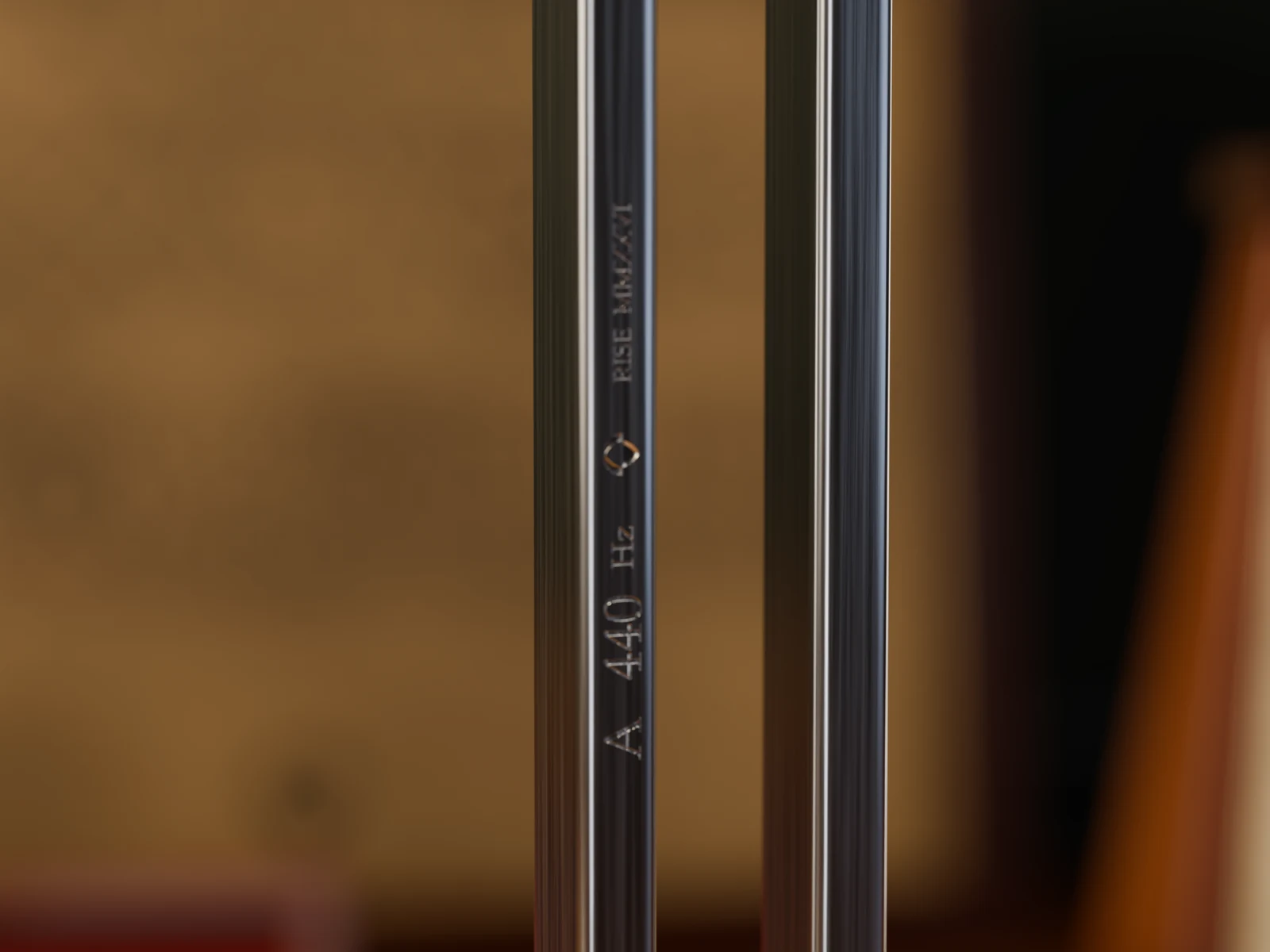
Close view of a polished steel tuning fork engraved A 440 Hz
The number, cut into the exhibition fork. Rendered from the same model you can handle on this site.

Almost everyone

440 is the most common standard. The Berlin Philharmonic tunes to 443, a touch brighter.

And the exception

Cuban orchestras use 436. The standard is real, and it is still a choice.

The fork went to work.

Standards are agreements you can hear.

Return to the exhibition